
Kride: an out-of-order RISC-V CPU
Kride (KRIDECORE) is the case study the Kathryn paper builds its evaluation on: a Kathryn re-implementation of RIDECORE, a Verilog out-of-order superscalar RISC-V processor (https://github.com/ridecore/ridecore). RIDECORE was chosen deliberately for its complex microarchitecture — hazard-aware pipelining, arbitration across multiple data structures, non-deterministic selection logic, and intricate semi-FIFO mechanisms. Modeling that complexity in Kathryn shows the framework can handle advanced designs, and by extension anything with simpler control flow.
RIDECORE is used largely unmodified — only genuine defects were corrected (disabling its incorrectly implemented gshare branch predictor and fixing minor bugs), without altering its intended cycle-accurate microarchitecture. Kride targets the same RV32 ISA and runs programs compiled with the standard RISC-V GCC toolchain (excluding system calls).
Six-stage organization
Section titled “Six-stage organization”RIDECORE — and therefore Kride — is an out-of-order superscalar RISC-V CPU with a six-stage pipeline: fetch, decode, dispatch, wake-up, execute, and complete/retire. The front end (fetch, decode, dispatch) is in-order and issues up to two instructions per cycle; the back end (wake-up, execute, complete/retire) is multi-lane. Branch and load/store instructions execute in order, while ALU and multiplier instructions execute out of order.
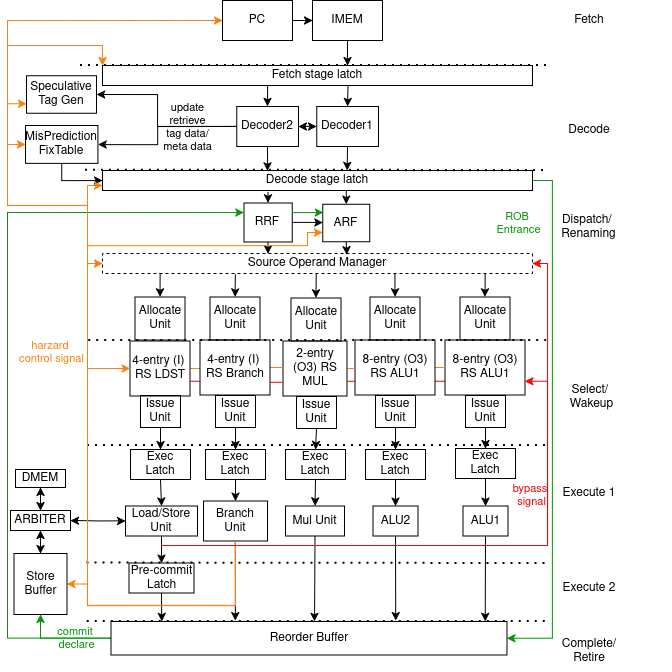
flowchart TB
    FETCH["Fetch<br/>PC and IMEM (in-order)"]
    DECODE["Decode<br/>Decoder1 and Decoder2 (in-order, 2-wide)"]
    DISPATCH["Dispatch / Rename<br/>RRF, ARF, source-operand manager (in-order)"]
    WAKEUP["Wake-up / Issue<br/>five reservation stations select ready ops"]
    EXECUTE["Execute<br/>ALU1, ALU2, MUL, branch, load and store"]
    RETIRE["Complete / Retire<br/>reorder buffer, store buffer"]
    FETCH --> DECODE --> DISPATCH --> WAKEUP --> EXECUTE --> RETIRE
    RETIRE -. "commit and mispredict recovery" .-> FETCH
The stage names map directly onto the module tree in src/example/o3/core/:
FetchMod (fetch.h), DecMod (decoder.h), DpMod (dispatch.h), the five
reservation stations plus their issue logic (irsv.h/orsv.h/rsvs.h), the
execution units (execAlu.h, execMul.h, execLdSt.h, execBranch.h), and
the Rob (rob.h) with the StoreBuf (storeBuf.h) at retire.
Repository layout of src/example/o3/
Section titled “Repository layout of src/example/o3/”The case study lives under one example directory, split by concern:
src/example/o3/ core/ the microarchitecture — every pipeline stage and data structure generation/ O3_gen — drive the model down the Verilog backend simulation/ o3_sim, TopSim, slot recorders, sim probes simCompare/ cycle-by-cycle co-simulation harness vs. RIDECORE (Verilator) countMeasure.py / countCompare.py the LOC-measurement scriptscore/holds the microarchitecture itself: the pipeline-stage modules and the shared data structures (ROB, reservation stations, register files, store buffer, tag generation, broadcast network).core/core.hassembles them all into oneCoremodule.generation/containsO3_GEN_MNG(O3_gen.h/.cpp), which builds the model and drives it through Kathryn’s Verilog generator.simulation/wraps the core in a simulationTopSim(top.h) with instruction/data memory, and adds the slot recorders and sim probes used for waveform capture and profiling.simCompare/is the co-simulation harness: a Kathryn-side controller and a RIDECORE-side (Verilator) controller run in lockstep and compare architectural state each cycle. This backs the 100% cycle-accuracy claim.
Line-count measurement sources
Section titled “Line-count measurement sources”The measurement scripts behind the line-count results live in
src/example/o3/count_measure
on the phase-8-tcad-major-revised branch.
Where to go next
Section titled “Where to go next”- Building and running — how to compile and drive a Kathryn design.
© 2026 Tanawin Devaveja. All rights reserved. The canonical version of this documentation is published at kathryn-tools.org.