
Decentralized update and priority
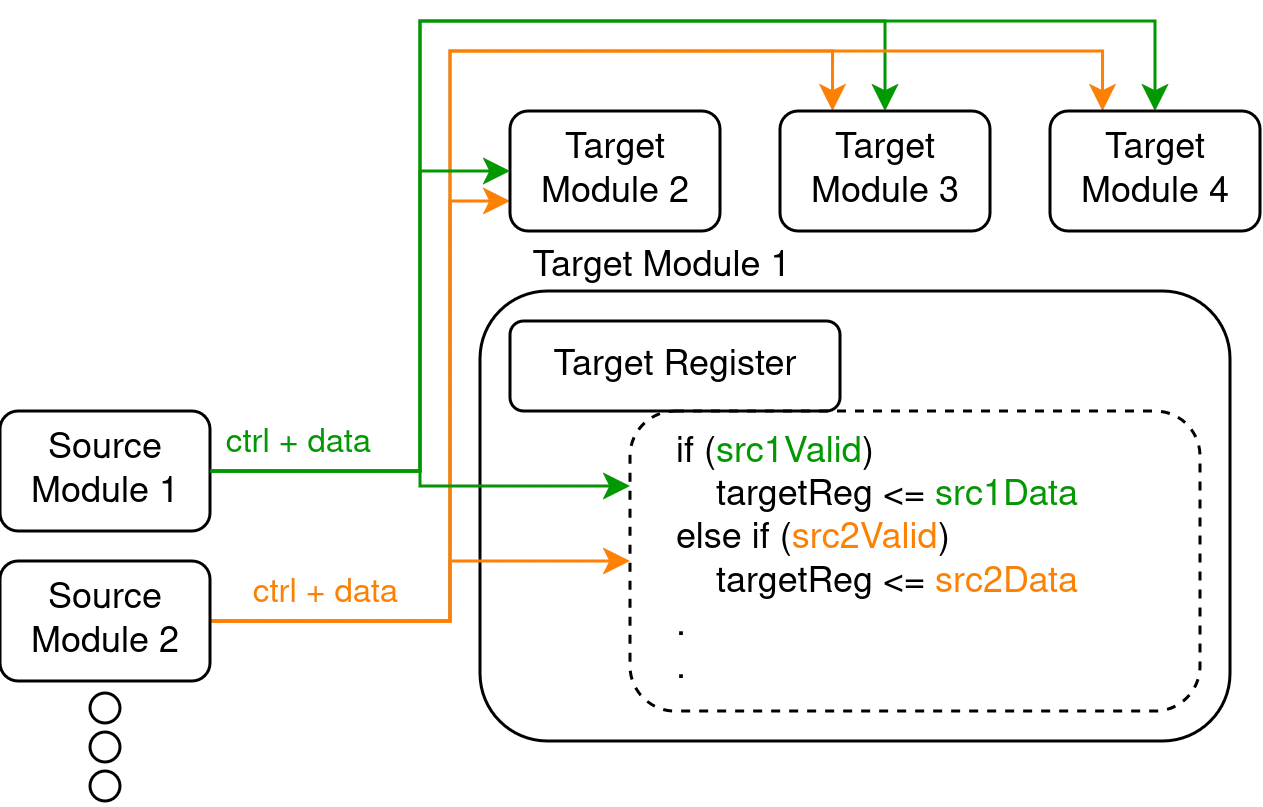
Decentralized Update is the second of Kathryn’s three abstractions. Its
promise is simple: any block, anywhere, may update a resource. An assignment
does not mutate a register directly and it does not have to be funneled into a
single hand-written driver. Instead each <<= (Edge Assignment) or = (Level
Assignment) records an update event on the target resource, and the
framework resolves competing writes by priority.
How competing writes resolve
Section titled “How competing writes resolve”- Ordinary user writes all carry the same default priority
(
DEFAULT_UE_PRI_USER). - When several writes hit the same resource in the same cycle, the highest priority wins.
- A reset event outranks every user write — a held reset pins the register to its reset value no matter who else is writing.
Minimal example
Section titled “Minimal example”To rank one write above another, bracket it with
SET_ASM_PRI_TO_MANUAL(p) / SET_ASM_PRI_TO_AUTO(). From autoSim
simAutoTest63:
SET_ASM_PRI_TO_MANUAL(DEFAULT_UE_PRI_USER + 1); // rank the next write higherb <<= 48;SET_ASM_PRI_TO_AUTO(); // back to the defaultb <<= 24;Both writes target b in the same cycle; the bracketed one has the higher
priority, so b becomes 48.
The two writers do not have to sit next to each other — that is the point of the abstraction. Any two blocks can write the same resource from wherever they are, each with its own priority, and no central FSM ever owns the resource’s writes.
flowchart LR
W1["writer 1<br/>SET_ASM_PRI_TO_MANUAL(USER + 1)<br/>b <<= 48"] -->|"event, higher priority"| POOL["update events of b"]
W2["writer 2, default priority<br/>b <<= 24"] -->|"event"| POOL
POOL -->|"highest priority wins"| REG["b = 48"]
Where to go next
Section titled “Where to go next”- The event structs and pool machinery behind this, for contributors: Driven Logic Structure.
- Stages that write shared resources like this: pip and zync.
© 2026 Tanawin Devaveja. All rights reserved. The canonical version of this documentation is published at kathryn-tools.org.